
e-Bulletin July 2026
MILESTONES |
Sir Patrick Manson: The Father of Tropical Medicine and His Enduring Legacy
Architect of Global Health and Founder of Hong Kong’s Medical Education
Everyone knows the School of Public Health is located at the Patrick Manson Building on 7 Sassoon Road, but are you aware of our deep-rooted connection to Sir Patrick Manson, the “Father of Tropical Medicine”? A Scottish parasitologist and pioneer in the field of tropical medicine, Sir Patrick Manson’s legacy is deeply woven into Hong Kong’s medical heritage, continuing to inspire our School’s mission to advance public health in Asia and beyond.
Sir Patrick’s relationship with Hong Kong began in 1883 when he arrived in Hong Kong and established a successful private practice. His commitment to advancing medical education led to a landmark achievement in 1887 – the founding of the Hong Kong College of Medicine for Chinese, where he served as its first Dean. This institution was the precursor to the HKU LKS Faculty of Medicine and trained Dr Sun Yat-sen, who was among Sir Patrick’s first students. Through this endeavour, he laid the very foundation for Western medical education in Hong Kong.
Sir Patrick’s most transformative contribution to global health was his ground-breaking discovery in 1877 that insects transmit diseases to humans. While working in Amoy (now Xiamen), he proved that mosquitoes were the intermediate host for the parasite causing elephantiasis (filariasis). This revolutionary finding shifted the medical understanding of tropical diseases from atmospheric causes to infectious, insect-borne processes, transforming treatment and prevention strategies worldwide. He was also the first to hypothesise that mosquitoes transmit malaria, mentoring Ronald Ross in India, who later proved the theory and was awarded the Nobel Prize for the discovery in 1902.
After returning to London, Sir Patrick founded the London School of Hygiene & Tropical Medicine in 1899, which remains a world-leading institution today. However, his influence continued to shape Hong Kong through the establishment of the Alice Memorial Hospital, where he played an instrumental role in bringing modern medical care to the local community. In an unusual yet impactful endeavour, he also imported cows from Scotland to Pokfulam in 1886 to establish the Dairy Farm company, providing safe, disease-free milk to Hong Kong’s residents – a true testament to his holistic understanding of public health.
Today, Sir Patrick’s name lives on at HKU through the Patrick Manson Building, and globally through the Schistosoma mansoni parasite and the prestigious Manson Medal, awarded to outstanding contributors to tropical medicine. As our School continues to address pressing health challenges in Hong Kong and across Asia, we draw inspiration from Sir Patrick Manson’s trailblazing spirit, dedication to education, and unwavering commitment to improving human health. His pioneering work reminds us that transformative change often begins at the intersection of scientific curiosity, compassion, and a steadfast belief in the power of education to shape a healthier future.
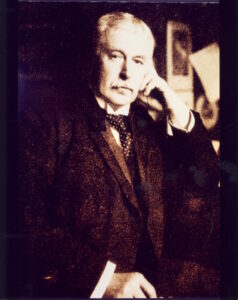 Sir Patrick Manson