e-Bulletin October 2026
IN THE MEDIA |
Revealing How Emerging Omicron Variants Exploit Different Routes of Transmission
New Findings Point to Potential Spread Beyond the Respiratory Tract
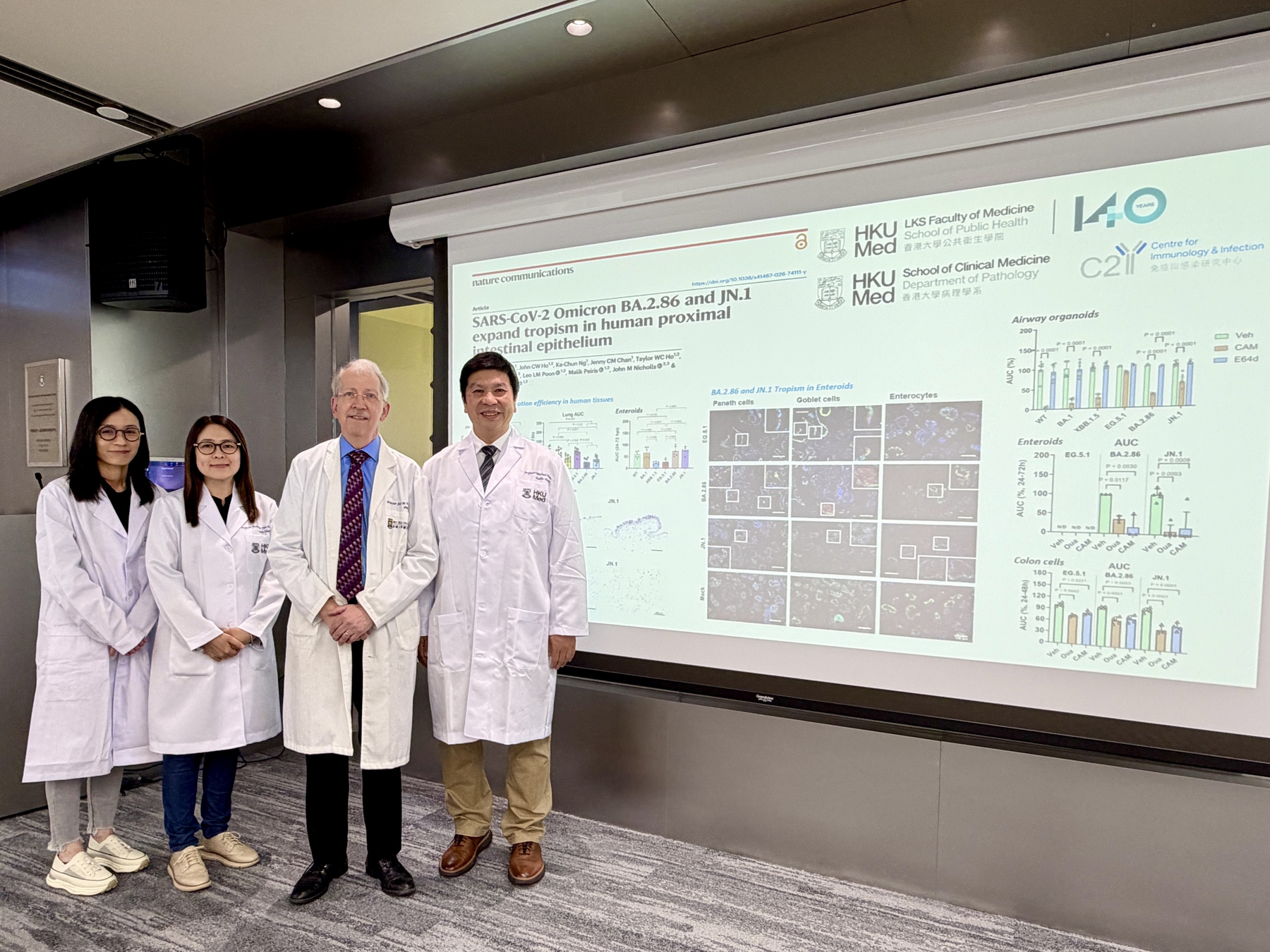
A study led by Professor Michael Chan, Professor of our School, with Professor Kenrie Hui, Assistant Professor also from the School, contributing as the first author, has discovered that emerging Omicron sublineages of SARS-CoV-2 use distinct biological strategies to spread and cause disease. Specifically, XBB.1.5 and EG.5.1 are better adapted for respiratory spread and may pose a greater risk of severe respiratory disease, while BA.2.86 and JN.1 tend to replicate more effectively in the intestines, potentially opening up alternative routes of transmission. The findings highlight the importance of ongoing monitoring and functional characterisation of emerging strains to support public health planning and preparedness for future outbreaks.
The study found that several Omicron sublineages, including BA.5, BA.5.2.1, XBB.1.5, and EG.5.1, replicate efficiently in human respiratory tissues. This suggests that these variants are particularly effective at infecting and multiplying in the airways and lungs, which may facilitate person-to-person transmission and potentially increase the risk of severe lung disease. Among the variants studied, EG.5.1 showed particularly notable features.
Professor Michael Chan said, “EG.5.1 can enter human cells through two different pathways, making it easier to infect tissues. It also showed enhanced growth in alveolar epithelial cells, which are located deep in the lungs, suggesting a stronger ability to infect the lower respiratory system and potentially causing more serious illnesses.” The researchers observed a similar pattern in XBB.1.5, which also replicates efficiently in respiratory tissues, indicating a high level of transmissibility.
The study found that BA.2.86 and JN.1, in contrast, replicate less efficiently in respiratory tissues but demonstrate higher replication levels in proximal intestinal enteroids, suggesting better adaptation to certain parts of the intestine — though this was not observed in colon cells. Notably, JN.1 exhibits a stronger ability to infect and grow in gut tissues while triggering relatively low levels of inflammation, suggesting the virus may persist in the gut without causing obvious symptoms, potentially increasing the possibility of transmission through faecal contamination.
The study also provides practical insights for laboratory studies, demonstrating that airway organoids are more reliable for studying how SARS-CoV-2 enters and infects human cells. The findings also suggest that the proximal intestine may be more relevant than the colon when investigating potential faecal–oral transmission.
The findings have now been published in Nature Communications. Click here to view the publication.